This past weekend I attended the Pittsburg Knit and Crochet Show (www.pghknitandcrochet.com) in Pittsburgh, PA! This was the 10th year the show has been presented. It was the perfect show to get my feet wet at this type of event, and I came away renewed and refreshed, ready to try my hand at more jewelry, some art pieces, and working with hemp and linen this summer.
A cadre of experienced fiber arts instructors offered a wide variety of classes for knitters and crocheters at any level. Special events included a pj party, a keyote dinner and book signings with well-known author Debbie Macomber, who also has a new yarn line out, and brunch with pattern designer and author Nicki Epstein. The show also included a large vendor market, with yarn makers and retailers from as far as Texas and Maine, plus a rotating trunk show, with 30-45 minute presentations by different pattern designers, yarn producers and yarn retailers. It was so much fun to see and touch items that I've seen pictured in pattern books 'live and in person.'
Meeting so many wonderful people in one place who were just as (or even more!) passionate than me about yarn and crochet was a joy. I was happy to be able to offer others my tips, and to receive fantastic tidbits from others. I fully enjoyed the Freeform Crochet class I took, led by Lauren Etling, who was warm, charming and fantastic at teaching.
I definitely intend on attending another event in the future. Next time, I'd like to either travel with one or more fellow fiber fanatics, or meet up with a few at the conference. Especially at any larger markets, it would help to have several people working together cruising the marketplace for deals and particular fibers. I needed the two days to see everything at this one!
Showing posts with label crafting. Show all posts
Showing posts with label crafting. Show all posts
Monday, March 17, 2014


Friday, March 29, 2013
Cashmere Part II

In the meantime, I've been learning a little more about cashmere, thanks to The Fiber of My Being(http://www.thefiberofmybeing.net/), a spectacular place to learn about fiber, spinning, dyeing, and a great source for wonderful yarns. There are many educational tutorial videos there, also. Sales proceeds go to support their fiber animal rescue operation! That's right - they rescue animals in terrible circumstances, give them a new home and good care, and use their fiber to make yarn. A truly remarkable and worthy effort, IMHO.
Recent additions to the farm include goats, from which they are harvesting cashmere, cashgora and angora fiber. Their research has revealed that there is no particular breed of goat favored for producing cashmere, per se. A cashmere goat is a type of goat, which could be one of many different breeds, that produces hair with certain measured cashmere characteristics of softness and fineness. In addition, a goat that grows cashmere doesn't necessarily grow it for its entire life! A goat's coat typically gets thicker and coarser over time. So even more reason why cashmere is so darn precious and expensive!
Friday, February 8, 2013
Recycled Cashmere Rocks!
I recently came across a tidbit of info that finally made it clear to me why I can't afford a complete cashmere wardrobe.
Cashmere yarn is spun from the softest underbelly hair combed from Cashmere goats, bless their hearts, and one Cashmere goat can only grow about 4 ounces of this luscious fiber per year. On average, it takes about 32 ounces of fiber, or eight goats, to produce one medium-sized adult sweater.
Just take a second and let that sink in.
Eight goats, lovingly fed, watered, tended, and combed. For a whole year. For ONE sweater! To be more realistic, I calculate a sweater for me would take, kindly estimated, say, twelve animals. Well, no wonder!! And no, I don't have the time, land or unique goat whispering skills to tend my own herd. Don't think I hadn't thought of that... briefly.
This is why I will be ever and eternally grateful for the dedicated people out there who have taken it upon themselves to retrieve Cashmere items no longer wearable, and painstakingly deconstructed these items in order to reclaim perfectly wonderful yarn for reuse. The task is not for the faint of heart, as any yarn addict will know, and the effort, IMHO, deserves our highest praise and our cash whenever possible.
Because it seems, in fact, that the word about how wonderful Cashmere is has been getting around. An increasing worldwide demand for very soft clothing is causing no small overgrazing problem in China, where the majority of Cashmere goats live. Please know that in no way do I begrudge any goatherding family its fair share of the economic pie. My philosophy is that all humans deserve the opportunity to make an honest living and provide for their families. However, I also know that it'd take a heck of lot of goats to supply anywhere near the full demand for this fiber. I mean, have you groped a hank of Cashmere lately, people?!
SO. Here's what I do, and what I hope to inspire you to do, when you have a project for which only Cashmere fits the bill. Look around in your local yarn store and/or online, and purchase reclaimed yarn. I'd consider it a personal favor, too, if you'd consider the distance the yarn might have to travel using fossil fuels to get to you and buy from as close a location as possible. Though still dear in price, you will be doing a small business, yourself and the Earth a world of good.
Cashmere yarn is spun from the softest underbelly hair combed from Cashmere goats, bless their hearts, and one Cashmere goat can only grow about 4 ounces of this luscious fiber per year. On average, it takes about 32 ounces of fiber, or eight goats, to produce one medium-sized adult sweater.
Just take a second and let that sink in.
Eight goats, lovingly fed, watered, tended, and combed. For a whole year. For ONE sweater! To be more realistic, I calculate a sweater for me would take, kindly estimated, say, twelve animals. Well, no wonder!! And no, I don't have the time, land or unique goat whispering skills to tend my own herd. Don't think I hadn't thought of that... briefly.
This is why I will be ever and eternally grateful for the dedicated people out there who have taken it upon themselves to retrieve Cashmere items no longer wearable, and painstakingly deconstructed these items in order to reclaim perfectly wonderful yarn for reuse. The task is not for the faint of heart, as any yarn addict will know, and the effort, IMHO, deserves our highest praise and our cash whenever possible.
Because it seems, in fact, that the word about how wonderful Cashmere is has been getting around. An increasing worldwide demand for very soft clothing is causing no small overgrazing problem in China, where the majority of Cashmere goats live. Please know that in no way do I begrudge any goatherding family its fair share of the economic pie. My philosophy is that all humans deserve the opportunity to make an honest living and provide for their families. However, I also know that it'd take a heck of lot of goats to supply anywhere near the full demand for this fiber. I mean, have you groped a hank of Cashmere lately, people?!
SO. Here's what I do, and what I hope to inspire you to do, when you have a project for which only Cashmere fits the bill. Look around in your local yarn store and/or online, and purchase reclaimed yarn. I'd consider it a personal favor, too, if you'd consider the distance the yarn might have to travel using fossil fuels to get to you and buy from as close a location as possible. Though still dear in price, you will be doing a small business, yourself and the Earth a world of good.
Sunday, January 27, 2013
The Gift Within the Gift
This Christmas, my lovely sister-in-law, Ruthie, sent me a delicious skein of yarn, made with fine merino wool, cashmere and silk, and dyed a deep, rich, garnet red. This yarn is just dreamy. Soooo soft and warm. She stipulated that it was to be made into something for me - a treat!
You'd think that I would know exactly what I would want to make. Well, no. Especially lately. I've been having these creative voids these days - a combination of burnout after the busy holiday crafting season and cabin fever, I think. Mostly I've spent a lot of time groping this yarn, trying to get a feel (literally) for what it might want to be.
One thing I know: I want this yarn next to my skin a lot, for sure. Hat, scarf, cowl, mitts, socks, some kind of shoulder wrap? Lacey or solid? What stitch pattern(s)? Dimensions? Use a pattern already written or create my own? Use the yarn alone or add in other yarns? Add beading? Fringe? Ribbon? Oh, the possibilities!!
The design process can be overwhelming. And yet...
It strikes me that the real gift I have received here isn't just a skein of beautiful yarn. I've been given the gift of endless possibility and the opportunity to uniquely express myself. I've been given the gift of another's confidence in my creative ability. Best of all, I've been given the gift of having people in my life who understand that, for me, a simple skein of yarn means so much.
You'd think that I would know exactly what I would want to make. Well, no. Especially lately. I've been having these creative voids these days - a combination of burnout after the busy holiday crafting season and cabin fever, I think. Mostly I've spent a lot of time groping this yarn, trying to get a feel (literally) for what it might want to be.
One thing I know: I want this yarn next to my skin a lot, for sure. Hat, scarf, cowl, mitts, socks, some kind of shoulder wrap? Lacey or solid? What stitch pattern(s)? Dimensions? Use a pattern already written or create my own? Use the yarn alone or add in other yarns? Add beading? Fringe? Ribbon? Oh, the possibilities!!
The design process can be overwhelming. And yet...
It strikes me that the real gift I have received here isn't just a skein of beautiful yarn. I've been given the gift of endless possibility and the opportunity to uniquely express myself. I've been given the gift of another's confidence in my creative ability. Best of all, I've been given the gift of having people in my life who understand that, for me, a simple skein of yarn means so much.
Tuesday, January 22, 2013
Experimenting with Fair Isle Using Tapestry Crochet
This winter I'm determined to try at least a few of the techniques I have on my "to do" list, amassed over the past three years. January 2013 has been Fair Isle month for me, having found a book called 200 Fair Isle Motifs: A Knitter's Directory by Mary Jane Mucklestone while browsing the bookstore at the end of last year. The book contains wonderful instruction about all aspects of Fair Isle knitting, plus color photos and graph diagrams of 200 patterns, which can be easily transfered to crochet.
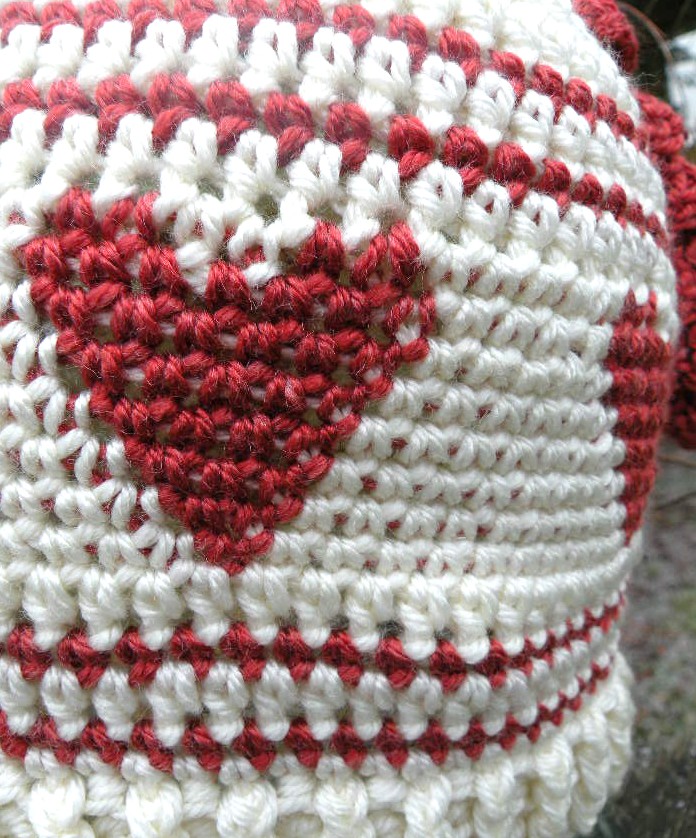
This type of color designing has also allowed me to try tapestry crochet - a method of carrying the unused color thread inside the stitches of the color being used, so that the back of the fabric contains no loose threads. A two-fer!!
Fair Isle knitting is said to have originated in the Shetland Islands of Scotland, which are actually located closer to Norway than Scotland. Traditional Fair Isle knitting patterns were made with various shades of fine wool spun from Shetland sheep. Alternating multi-color patterns typify the Fair Isle design. Usually, a smaller border-like pattern is alternated with a larger multi-color pattern.
I started simply with a base and accent color, trying out tapestry crochet as I went along and keeping the color changes straightforward (see the teal and white pattern below). Crocheting this way requires a lot of patience and untwisting of yarns as you progress! Then I began working in border patterns with shapes.
So far, I'm proud to show you what I've done - please tell me what you think and feel free to share your own attempts, if you've tried this, too!


This type of color designing has also allowed me to try tapestry crochet - a method of carrying the unused color thread inside the stitches of the color being used, so that the back of the fabric contains no loose threads. A two-fer!!
Fair Isle knitting is said to have originated in the Shetland Islands of Scotland, which are actually located closer to Norway than Scotland. Traditional Fair Isle knitting patterns were made with various shades of fine wool spun from Shetland sheep. Alternating multi-color patterns typify the Fair Isle design. Usually, a smaller border-like pattern is alternated with a larger multi-color pattern.
I started simply with a base and accent color, trying out tapestry crochet as I went along and keeping the color changes straightforward (see the teal and white pattern below). Crocheting this way requires a lot of patience and untwisting of yarns as you progress! Then I began working in border patterns with shapes.
So far, I'm proud to show you what I've done - please tell me what you think and feel free to share your own attempts, if you've tried this, too!


Sunday, January 13, 2013
My First Model and Print Ad!
Sometimes I forget to get the word out about what I'm trying to do. Thankfully, I have good friends who remember me! Recently, one of these friends worked out a rather complex barter deal that led to her daughter modeling my work for a print ad in a regional business magazine! I'm very grateful, and excited for me, the model and my friend - a triumph of collaboration :D.
Now... to flesh out that marketing plan...
Now... to flesh out that marketing plan...
Thursday, March 10, 2011
There's A Lot of Gray in Being Green - Part Two
More questions to consider when trying to be environmentally friendly with crochet:
If I order fiber from places too far for me to drive to, is it shipped separately, or can I have it delivered to my local store combined with a regulary delivery?
Some yarns I can only find online where I live. Take Caron's Simply Soft Eco or Red Heart EcoWays. None of my local craft stores (Michael's, Walmart and JoAnn's Fabrics - all big box stores) carry acrylic yarns with recycled content. My Michael's does carry two lines of organic cottons in limited colors, and non-organic USA-made Lily worsted weight cotton yarn, but no other yarns with recycled, repurposed, recovered or organic content. Thankfully, more stores are now offering to ship individual product orders to the nearest store instead of directly to my home. This way, it can be combined with shipments that would be going to the store anyway, requiring no separate truck use to get it to my house specifically. Then, I can pick it up when it is convenient for me, and when I'm combining my own trips around town.
Does the yarn producer incorporate ecofriendly practices and materials into its labeling and packaging?
I look for yarns that have simple labeling and low-impact packaging. More and more frequently, I'm noticing labels produced with a high percentage of post-consumer recycled paper content, as well as labels that indicate the paper is made from sustainably managed forest resources. I truly appreciate that producers are doing this, and letting me know by printing it on their labels! I'd love for them to tell me they're using soy/veggie ink for printing, too...
to be continued...
If I order fiber from places too far for me to drive to, is it shipped separately, or can I have it delivered to my local store combined with a regulary delivery?
Some yarns I can only find online where I live. Take Caron's Simply Soft Eco or Red Heart EcoWays. None of my local craft stores (Michael's, Walmart and JoAnn's Fabrics - all big box stores) carry acrylic yarns with recycled content. My Michael's does carry two lines of organic cottons in limited colors, and non-organic USA-made Lily worsted weight cotton yarn, but no other yarns with recycled, repurposed, recovered or organic content. Thankfully, more stores are now offering to ship individual product orders to the nearest store instead of directly to my home. This way, it can be combined with shipments that would be going to the store anyway, requiring no separate truck use to get it to my house specifically. Then, I can pick it up when it is convenient for me, and when I'm combining my own trips around town.
Does the yarn producer incorporate ecofriendly practices and materials into its labeling and packaging?
I look for yarns that have simple labeling and low-impact packaging. More and more frequently, I'm noticing labels produced with a high percentage of post-consumer recycled paper content, as well as labels that indicate the paper is made from sustainably managed forest resources. I truly appreciate that producers are doing this, and letting me know by printing it on their labels! I'd love for them to tell me they're using soy/veggie ink for printing, too...
to be continued...
Subscribe to:
Posts (Atom)